Introducing fluxkraft - web automation simplified with the power of Rules!

You might have heard some rumors about a tool called "fluxkraft": something like ifttt.com, but with Rules? Or what? Indeed, fluxkraft is one of our latest drunomics lab projects funded by netidee - a Austrian grant for powerful - and open - innovations, and yes - fluxkraft will be a tool for rule-based web automation, built as an open platform on top of Rules and Drupal! So, finally here are some first details on it:

So the idea is to build an easy to use Drupal distribution that allows you to automate various web-based tools like twitter, facebook and dropbox. Yes, you can do that already with services like ifttt.com, but fluxkraft will be an open platform, open-source and free for everyone to use and extend. That way, you can install it on your own servers and keep all the keys to your valuable data secured - and most importantly - under your control!
Then, as it's open source and will come with an API for adding connectors to new services you can simply integrate it with any service you want. So while the tool will provide some essential integrations for services like twitter and facebook from the start, the hope is that community will chime in and provide connectors to a variety of different online services.

Semantic content enhancements with Drupal, Apache Stanbol and VIE.js

As previously announced on the IKS blog I’ve been recently working together with Stéphane Corlosquet on integrating the tools provided by the IKS project to do semantic content enhancements in Drupal as part of the IKS early adopter program.

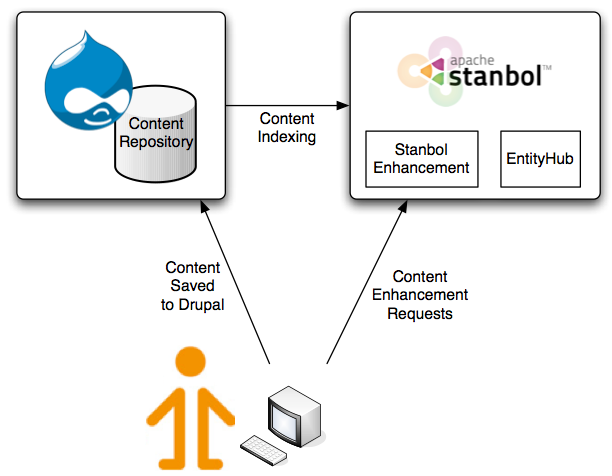
The Interactive Knowledge Stack (IKS) project is an open source community which got funded by the EU to build an open and flexible technology platform for semantically enhanced Content Management Systems. Thanks to IKS, open source projects like Apache Stanbol, VIE.js or Create.js got started. While VIE.js and Create.js are already on their way to Drupal 8 via the Spark initiative, our focus was on integrating Apache Stanbol with Drupal 7. In short, Apache Stanbol is a java web application that leverages tools like Apache Solr, Apache Tika or Apache OpenNLP to provide a set of reusable components for semantic content management via RESTful web services. On the front-end side, VIE.js (“Vienna IKS Editables”) is the JavaScript library for implementing decoupled Content Management Systems and semantic interaction in web applications.

For leveraging Apache Stanbol with Drupal we send Drupal’s data over to Apache Stanbol’s EntityHub component for indexing, such that it is available to Apache Stanbol’s content enhancer. That means, we can use VIE widgets like annotate.js to send pieces of text over to Apache Stanbol for auto-linking content items indexed to Stanbol, which by default includes DBpedia entities, but could be easily extended by any source providing data in RDF. Next, the VIE autocomplete widget allows for easy tagging based upon entities indexed with Apache Stanbol - regardless of whether they come from DBPedia or from one of the Drupal sites your organization runs!

There must be Rules at the Drupalcon Munich

As there must be Rules at the Drupalcon Munich as well, I've had a Rules session together with Richard Jones from i-KOS.

Head over to the session page for a summary and find the slides attached attached to this post as well. Moreover, you can find all the screencasts we've used during the presentation here as well. It's a real Drupal commerce site we've been using in the session to show how Rules can be used to solve real life problems.

1 - No VAT for certain products

2 - Discounts for products that are not belts or bags

and then to make it work the same way years ahead

3 - Subscribe to back in stock notifications via Flag module.

4 - Notify me when something needs review with Workbench moderation

5 - Execute Rules components from Views Bulk Operations

6 - Let's do promitions, but only on Monday please!

7. Message users if they abandoned their carts

8. Log user communication with the Message module

A New Entity Property API for Drupal 8

Why?

While the conversion to full CRUD for entities and classed objects for Drupal 8 made good progress, we’ve not yet reached the goals of fully translatable entities and having a default entity serialization for import/export, content staging and web services. For those points we need to know what’s in an entity! Yes we can look up the fields, but there are also base entity properties and further stuff modules put on entities, which both are no fields so we do not know anything about them.

That is what the new Entity Property API is supposed to change: It’s about providing a unified interface to entity properties and fields, avoiding the split between fields and non-field properties. So fields will be entity properties working with the same API as well! Then, it’s about being able to instrospect what’s going to be in an entity - regardless whether it has been added by a module or by the user via field UI. But furthermore, with classed entity objects as the basis we can improve the developer facing API and make it easier to access property and field values (I’m looking at you, $entity->field_body[LANGUAGE_NONE][0][‘value’]).

What?

As we’ve outlined in the WSCCI Web Services Format Sprint report we want to have a modern OOP, interface based API for properties. The API should allow for introspection, so that it’s possible to look up the defined properties of an entity type in advance. If you know the Entity property information system of the Drupal 7 Entity module, it’s a bit similar to that, but instead of adding an extra layer above the existing entities it’s about supporting it natively. So there will be no need for entity wrappers - all the easy API and information will be directly available in $entity.

See the Entity Property API meta issue for a more complete list of planned features.

Drupalcon Denver...

At the Drupalcon Denver I've given a talk called "Drupalize your data: use entities!". Check out the recording of my talk and find the slides attached:

Also, I've been instructing at the "Rules Mastery" training, together with Johan Falk, Dick Olsson and Klaus Purer. The training materials are all available online so check them out at http://tinyurl.com/rulesmastery! To get into Rules check out the The tiny book of Rules - kudos to Johan Falk again :-)

Going freelance

Some weeks ago I decided to go for something new and to start freelancing. Anyway, I'll keep up the good relationship with epiqo, but starting from December I'm going to work on a freelance basis and look out for other exciting possibilities and projects. Of course I keep maintaining my beloved Drupal modules. Moreover if everything goes well, I hope to be able to reserve more time for community work that way and/or to find new sponsors for exciting developments.

It's done: Rules 2 is out!

Finally, slightly more than two years after I started the initial development I'm happy to announce the release of Rules 2.0 for Drupal 7!

So what's new compared to Rules 1.x?

While the fundamental concepts of "Event-Condition-Action rules" and parametrized actions remain, Rules 2.x is a complete re-write - quite some things changed. Now, it's building upon the Entity API module to fully leverage the power of entities and fields in Drupal 7. Change a taxonomy term? - No problem. Moreover that, Rules 2 now allows you to just select any entity property or field via it's so called "data selection" widget:

Data selection

The Rules data selection widget shows all suiting data properties when configuring an action or condition argument. Let's consider, you configure an action to send a mail - by using the data selector comment:node:author:mail you can easily send mail to the comment's node's author. For that the data selection auto-complete helps you finding suiting data selector:

You might note, that data selectors like node:title look like token replacements. But as actions need more than just textual data, the data selector gives them back the raw data, e.g. full entity objects or whatever fits depending on the data type. Thus, data selectors are not implement via token replacements, but via the entity.module's Entity property info system. Still, the Entity Tokens module (comes with Entity API) makes sure there are token replacements available for all the data selectors too.

The very same way one can naturally access fields too - e.g. node:field-tags gets you all the tags of your article node. However as only articles have tags, for that to work Rules needs to know that the variable node is an article first. Thus, make sure you've used the "Content is of type" or the "Data comparison" condition to check it's an article. Analogously, if you have an "entity" data item you can use the Entity is of type condition to make sure it's a node and access node-specific properties afterwards!

Read more about data selection in the drupal.org handbooks.

Switching parameter input modes

Related, Rules 2 allows you to switch the input modes while configuring the argument for an action parameter. Consider, you have an action that works with a vocabulary. Usually people might select the vocabulary to work with from the list of available vocabularies, but in some circumstances one wants the action to use the vocabulary of a specific taxonomy term. This is, where switching parameter input modes comes into play as it allows you to switch from fixed input mode (= configuring a specific vocabulary) to the data selection input mode - so you could just configure term:vocabulary as an argument by using the data selection widget.

Rules 2 provides small buttons below each parameter's configuration form which allow you to switch the input mode:

Components

Components are standalone Rules configurations that can be re-used from your reaction rules or from code. In Rules 1.x there are already "rule sets" available as "components" - but with Rules 2.x there are multiple component types: Rule Sets, Actions Sets, Rules, "AND Conditions Sets" and "OR condition sets". Rule sets come with maximum flexibility, but if the extra layer of having multiple rules is unnecessary for your use case, you can go with the simpler action set or a single "rule" component now! Next, the conditions sets make it possible to define re-usable condition components.

Components work upon a set of pre-defined variables (e.g. a node), just as for Rules 1.x. However with Rules 2.x it's now possible to provide new variables back to the caller, too.

Read more about components in the drupal.org handbooks.

Loops and lists

Rules 2 is finally able to properly deal with loops and lists! That means you can now access all your fields with multiple items, e.g. the tags of an article node. So you can easily loop over the list of tags and apply an action to each tag. That's also very handy in combination with node-reference or user-reference fields. Send a notification mail to all the referenced users? No problem.

Furthermore, one can access individual list items directly using the data selector - just use node:field-tags:0:name to access the first tag. If you do so, you might want to check whether a tag has been specified by using the "Data value is empty" condition though.

Read more about loops in the drupal.org handbooks.

Improved debug log

Fortunately, there has been another Rules related Google Summer of Code project this year. Sebastian Gilits worked on improving the rules debug log as part of his project! Now, the debug log makes use of some Javascript and appears all collapsed by default, so it's much easier to get which events have been triggered and which rules have fired in the first place. Also, we've included edit links so you can easily jump from the debug log to the Rules UI in order to fix up a miss-configured rule.

Publishing Linked Open Data of Austria at the Vienna Create Camp 11

The last weekend I attended the Vienna Create camp 11, a great event for collaboratively creating applications related to open data and accessibility.

6 members of Drupal Austria formed a team to make use of open data published by the cities of Vienna and Linz. Unfortunately, it turned out that the data is published in various different data structures and formats, so re-using the data in an efficient manner is hard. It's nice to see that the city of Linz is using CKAN to publish the data, so there is some basic information about the data sources (format, url, ..) available. However, still each data set is published using different data structures, so making use of a data source requires writing or configuring a specific adapter.

So, we've started "drupalizing" the data by using feed importers, whereby we've configured one content type and feeds importer per data source. Fortunately, once the data is in Drupal we can use it with all of Drupal's tools. So publishing the data as Linked Open Data is as easy as enabling the "rdf" module of Drupal and providing some meaningful mappings. For that, we've made use of Schema.org vocabularies as far as possible.

Now, all imported data items are available via RDFa, RDF, JSON or XML. But most convenient is probably the Sparql endpoint, which enables one to directly query the published datasets. So finally, we have real Linked Open Data of Austria - yeah! Then, we've made use of Openlayers with some nice base layers from the TileStream powered kartenwerkstatt.at to create nice looking maps - check out the demonstration site.

Next, we've published our open data features at drupal.org, so everyone can easily make use of our work and quickly use all that data by using Drupal. See http://drupal.org/project/odv.

Unfortunately, the data of the city of Linz required some custom massaging in order to get proper geo coordinates from the project they used. Thus, we were not able to create easy to use feeds configurations for Linz as we've done for Vienna. Maybe the city of Linz improves that in the future...

Drupalcity Entity API talk slides

Here are the slides of the Entity API session of the Drupalcity.

Entity API core conversation slides

Attached are the slides of the Entity API + Entity Property API core conversation talk Peter Wolanin and me had today at the Drupalcon London. The video can be found here.

It pretty much just contains just some points and thoughts we discussed at the talk.

Pages

Subscribe to Wolfgang Ziegler // fago RSS